Sunday, April 17, 2011

Has the Percentage of Texas Public School District Staff Who Directly Impact Student Outcomes Changed over the Last 20 Years?

In a previous, I showed that the decrease in the percentage of teachers was largely due to an increase in support staff. But support staff is a catch-all that covers a wide variety of individuals. As it turns out, a fair percentage of support personnel are located at schools and have a direct impact on students. A significant percentage also provide teacher support. Below I review this in (agonizing) detail. The goal here is to document the percentage of individuals in positions that directly impact student outcomes. The reason for doing this is to determine how many positions could be cut without directly impacting student outcomes. I want to do this to disprove some comments by the governor, other politicians, and lobbyists that school districts are choosing to lay off individuals who directly impact student outcomes.

Why all the Detail?
Stay with me through the post (or skip to the end for the big bang if you are swamped at work and then re-read all the way through when you have time). The reason I go through the agonizing detail is that too many politicians, pundits, and media make claims without providing any substantiation. This is how we get into trouble. What we need is an independent organization to provide unbiased reports that are substantiated with data. TEA could provide such data, but TEA staff communicated to me that they simply do not conduct any research that is not prescribed by federal or state law. This is unfortunate because they could provide data such as in this post so that policymakers and the public could have a common understanding of the situation, thus make more informed decisions.
On to the DATA!!!

As shown in Table 1,the greatest numerical increase was for those providing student support with an increase of almost 14,000 FTEs over a 20 year time period. In addition, there was an increase of almost 7,000 FTEs in student special education support. Thus, almost 21,000 of the approximately 38,000 increase were FTEs in positions directly impacting student outcomes. There was a large increase in administration, with general support having an increase of almost 12,000 FTEs over the 20 year time period.

Table 1: Support Personnel by Broad Job Area (1991, 1996, 2001, 2006, & 2011)

As shown in Figure 1, data at this broad level suggests that about 54% of the increase in support personnel were in positions that directly impacted students (student support + student special education support). Around 31% of the increase was for general support. Thus, most of the increase was for student support, but there was also an increase for other support. While we could stop at this level–and many people do–let’s dig deeper. Why? Because we can . . .  and the more detail, the better we can determine what is really going on.


Table 2, shown below, provides more detail on the specific job titles of those in the broader job codes above. The largest increases were for counselors, librarians, other campus professionals, teacher facilitators, and other non-campus professionals. Clearly, counselors and librarians provide direct student support. But what about other campus professionals and non-campus professionals?

Table 2: Support Personnel by Specific Job Description (1991, 1996, 2001, 2006, & 2011)
 

But what about these other campus professionals? What do they do?

Well, Table 3 below reveals in detail the job titles of these individuals. I have arranged them in broad categories that are of my own making. Undoubtedly, the greatest numerical increase was for those providing teacher support and assistance. When combining all areas that directly impact student outcomes (student support, discipline management, and special education), there was an increase of over 1,000 FTEs. But, this table shows that not all of the other campus professionals have a direct impact on student outcomes.

Table 3: Number of FTEs for Other Campus Professionals
in 1991 and 2011 by Job Title

Who are these non-campus professionals? The TEA role code describes them as holding non-instructional positions. But let’s see. You never know until you check.

The details are below in Table 4. Almost all of these non-campus professionals were either general administration or operations. Thus, almost all of these individuals do not directly impact student outcomes.

Table 4: Number of FTEs for Non-Campus Professionals in 1991 and 2011 by Job Title

So, let’s summarize.

In Table 5, we see that the majority (79%) of other campus and non-campus professionals are NOT in positions that directly impact student achievement. Thus, we need to revise figure 1 since using the broader categories mis-classifies a number of individuals.

But, let’s not lose the forest for the trees here. We are talking about 20,000 of the over 61,000 FTEs that are support personnel in 2010-11.

But clearly, the data as categorized by TEA at the role code level is not detailed enough to determine the percentage of individuals in positions that directly impact student achievement and that is what wee ultimately want to know.
Table 5: Number of Other Campus and Non-Campus Professionals
by Job and Relationship to Student Outcomes

PERCENTAGE OF STAFF DIRECTLY IMPACTING STUDENT OUTCOMES

To determine the number of individuals in positions that impact student outcomes, I had to go to the individual employee data from TEA. This data includes each person’s assignment and partial FTE (full-time equivalent) for that assignment as well as the partial base pay for that assignment.

Table 6 shows the role codes, role code descriptions, and the designation of each role as having a direct or indirect impact on students. All teachers, educational aides, principals, assistant principals, counselors, librarians, social workers, work-based learning coordinators, visiting teachers, truancy officers, and all special education staff have a direct impact on students. This is true regardless of whether the individual is designated as being located at a school or central office.

Other campus professionals are located in several areas, depending on their specific job title. Some are school-based student support staff, others are teacher support staff, and even others are district support staff.
Superintendents, associate superintendents, assistant superintendents, directors, executive directors, coordinators, managers, business managers, HR directors, and athletic directors are all designated as central office administration. Everyone else is considered central office support.
Table 6: Role Codes and Descriptions and Designation of Direct or Indirect Student Impact

Staff Directly and Indirectly Influencing Student Outcomes
Okay–enough playing around–let’s get to the bottom lime.

Below I show the number and percentage of all staff in positions that directly impact student outcomes or indirectly student outcomes. As shown above, determining which roles and jobs directly impact student outcomes is pretty straight-forward for most roles and positions. The support staff positions–in particular the “other campus professionals” and the “other  non-instructional/non-campus professionals” are where the difficulty lies. As it turns out, however, some of the administrator positions are mis-coded as well. Using the individual person-level data allows me to identify each person’s role and job and determine whether the position directly or indirectly impacts student outcomes.

Before showing the results, let’s review who directly impacts student outcomes:
1) teachers and educational aides since they are in classrooms every day with students;
2) principals, assistant principals, nurses, counselors, and librarians–any one who has worked in schools or who had children in schools knows that all of these individuals help students achieve educational outcomes; and,
3) Special education specialists, whether at a school or at the central office, make a critical difference in the lives of students with special needs and without these staff, many students would suffer academically and emotionally.

Those who do not directly impact student outcomes are:
1) School-based curriculum and instructional specialists (many would argue that they do directly impact student achievement, but I’ll play it conservatively);
2) Central office leaders (superintendents, associate superintendents, and managers), administrative staff (business-related positions and human resource staff), curriculum and instructional specialists, and operations personnel (plant maintenance, food processing, transportation, etc.); and,
3) auxiliary staff (bus drivers, custodial staff, etc).
As we see in Table 7, the total percentage of staff directly impacting student achievement in 1991 was 67.8%. In 2011, the percentage dropped 0.1%. Oh the bureaucracy!!!! We have gotten so top-heavy in the last 20 years. We have plenty of room to cut positions without harming students!!

Table 7: Number and Percentage of All Staff in Positions 
Directly and Indirectly Influencing Student Outcomes


What???? Let’s check that again with a simple bar graph!

FIGURE 2: Percentage of Total Staff in Positions 
Directly and Indirectly Influencing Student Outcomes


I don.t know about you, but those bars look pretty much the same. As Charles Barkley says, “I could be wrong, but I’m probably not!”
Could other organizations done this same analysis? Sure–the data from TEA is accessible to anyone with a checkbook. Yet, why dig down to the very details when you can make your own ideological point using data that you never checked and can;t be checked by anyone else?
Hope you enjoyed the post. Next? If 67% of staff directly impact student outcomes, then can we keep all 67% under the current House Budget?

Saturday, April 16, 2011

Charter School Student Attrition: The Case Of Harmony Middle Schools

This short post is a teaser about a charter school study I am currently working on that examines student disappearance rates, ability levels of students entering charter schools, and the ability level of students leaving charter schools. This teaser post focuses on Harmony Schools in Texas run by the Cosmos Foundation.

Recent attention has been focused on the schools’ ties with the Gulen movement in Turkey and the use of H1B visas to replace American teachers with Turkish teachers. While I am interested in those issues, I focus on student mobility patterns and student achievement related to those patterns.

This study was  funded by the Texas Business and Education Coalition (www.tbec.org) , an independent organization focused on improving school outcomes for all students.

I chose to focus on Harmony Schools because supporters of these schools have claimed on a number of different websites that my figures are wrong and I have falsely claimed high disappearance rates for Harmony schools. This post will surely lay rest to this issue. At least for Harmony Schools in Texas.

Data for the Study

The study relies on individual student-level data purchased from the Texas Education Agency. The data has the Texas Assessment of Academic Skills (TAKS) scores and the school/school district in which the student was enrolled during the spring administration of the TAKS tests. Thus, the data can be used to follow students from one year to the next as long as they are enrolled in a grade level in which a TAKS test is administered. In Texas, this includes grades 3 through 11. Students not taking the test, but enrolled in the school are still included in the data. The data is masked for FERPA compliance, but student masking simply removes the test score, not the enrollment data.

For a school to be eligible for the study, it had to have at least 10 students enrolled n grade 6 in 2008, grade 7 in 2009, and grade 8 in 2010.

Student Disappearance

Student disappearance was defined as the percentage of students enrolled in the 6th grade in 2008 who were still enrolled in the school in any grade level in 2010. Students could still be enrolled in another public school school in Texas or could have left the Texas public school system to move to another state/country, enter a private school, or participate in home schooling.

Figure 1 has the percentiles for all schools, including charter schools and traditional public schools. The data for public schools has not been corrected for schools in fast-growth districts where substantial percentages of students change schools when a new school opens. Ultimately, this correction will be included which will lower the disappearance rates for traditional public schools. Charter school disappearance has been corrected for transfer to a school under the same charter operator. For example, if a student transfers from one Harmony school in Houston to another Harmony school in Houston, then that student is NOT counted as having disappeared from the original school.


Harmony Schools

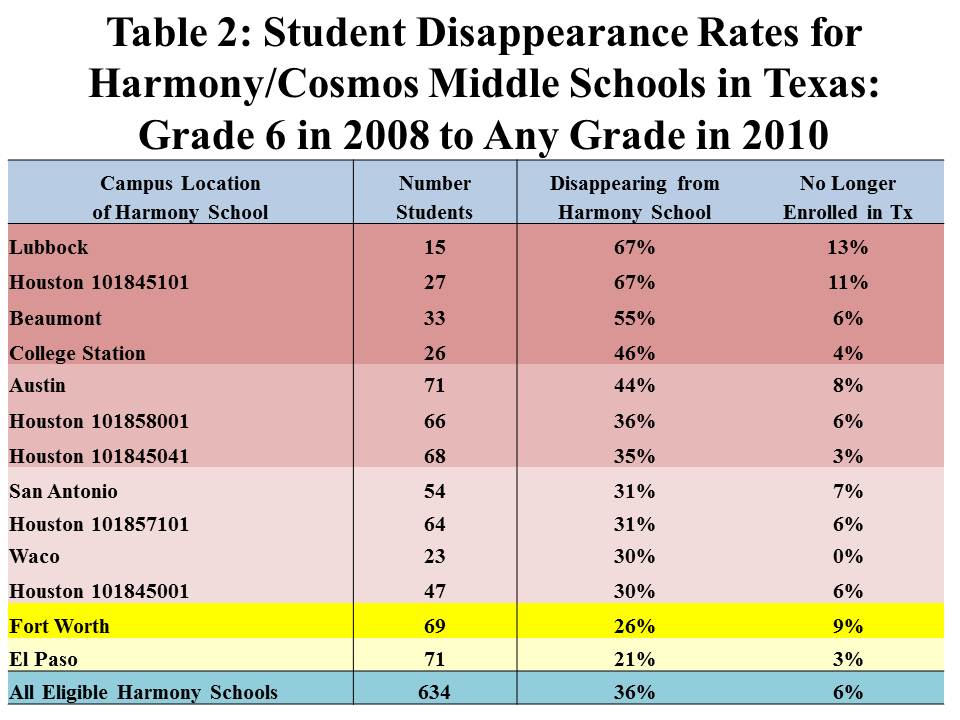
As shown in Table 2, a number of Harmony Schools had disappearance rates that were extremely high relative to all schools. Indeed, 7 of the 13 schools had disappearance rates that were greater than 80% of other schools in the state. Most of those who have disappeared from the schools have transferred into other schools. The percentage of students no longer enrolled in Texas public schools is provided in the last column.
What I find interesting is the claim that there are long waiting lists to enroll in Harmony Charter Schools. I don;t doubt the claim–I think there probably is a waiting list for such schools. But why do so many students choose to leave the Harmony Charter Schools after they have enrolled? Were they pushed out? Did they leave on their own? If they left on their own, what was the reason?

I believe the data suggests that a substantial number of students and parents become disenchanted with the schools and transfer to another school. I see no other explanation when over 50% of students leave a school. But I could be wrong.

SOURCE: Student TAKS data, TEA; ANALYSIS: Ed Fuller, PhD

Characteristics of Students Disappearing from Harmony Schools: Performance Level

As shown in Table 3, there were 614 students with valid math TAKS scores. Of these students, 46.9% scored more than .2 standard deviations below the school average (red rows) while 38.1% scored at least .2 standard deviations above the school average (green rows). Column 3 (% students disappearing from school) shows that lower performing students had a greater disappearance rate than higher performing students.Indeed, 61% of the lowest performing students (those who scored more than 1 standard deviation below the school average) disappeared from Harmony Charter Schools while about 31% of the highest performing students disappeared. Almost 55% of those who disappeared were low performing students (red rows) while almost 30% of high performing students (green rows) disappeared.
Thus, a disproportionate percentage of lower performing students disappeared from the school. This is one way to increase the overall average performance and obtain higher accountability ratings than otherwise would have been obtained.

SOURCE: Student TAKS data files, 2008 through 2010, TEA: Analysis: Ed Fuller, PhD

Does this happen in other charter school systems? Yes.
In traditional public school districts? Yes.

So, we have to remember that these results may be typical of all charter and public district systems. The final report will place these numbers in the context of other charter and district systems.

I’m sure many of you are wondering if the same analysis can be done with KIPP schools. Yes, it can! I have already done that analysis and it will be released concomitant with the release of the report through TBEC.


More to come on charter schools!!

But the next post will return to employment issues and the percentage of educators having a direct impact on student outcomes. I will tell you this–the number is high enough that budget cuts will force districts to cut teachers despite what Governor Perry and other Republican leaders are claiming.

Analysis of Educator Roles and Responsibilities in Texas: 1991-2011

During this budgetary crisis, there has been much discussion about what school district employees in Texas actually do. Some people have claimed that we used to have five teachers to every one non-teacher in the 1970s while we now have one teacher to every one non-teacher. Others have claimed that districts are choosing to cut teachers instead of cutting other staff first. There has been precious little evidence produced that substantiate these claims other than proclamations by legislators and organizations generally aligned with more conservative perspectives on education.

This entry examines the first claim that asserts the ratio of teachers to non-teachers has decreased dramatically over time and, by implication, there is a vast bureaucracy of non-teachers that have little impact on student outcomes and are a waste of tax-payer dollars. This claim, however, is related to the second claim. The second claim—that we can cut non-teaching positions and do little harm to student outcomes such as test scores—assumes that those in non-teaching positions do little to impact student outcomes. This was the rationale provided in the recent push to require that 65% of expenditures go towards instruction.
This paper examines the assumptions behind these claims and closely examines employment trends in Texas public schools. Fortunately, TEA collects individual employment and responsibility data for every education professional in Texas public school districts. This data extends back to 1987-88 and goes through 2010-11. I have purchased this data for all 23 years and have analyzed the data starting in 1989-90 through 2010-11.

Claim #1: Employment Trends by Position for 20 Years


The first claim is that the ratio of teachers to non-teachers has declined over time because school districts have hired more non-teachers than teachers over the last 20 years.

Examination of Assumptions
Before directly addressing this claim, it is worth identifying and examining the assumption behind this claim. The assumption behind this claim appears to be that teachers are the most important school variable related to student achievement and, consequently, hiring non-teaching staff is a waste of money since such individuals do not impact student achievement as directly as teachers.

For example, the Texas Public Policy Foundation (2011, p.1) argues that,
“it is clear that Texas is not spending its education dollars wisely or efficiently, in large part because the money is not getting to the students in the classroom.”
Similarly, in their report for the Lone Star Foundation and Americans for Prosperity, Hartman and Lutz (n.d.) claimed “explosive growth of non-teachers, as compared to teachers” was inefficient and non-teaching positions should be reduced. In essence, conservative voices have argued that the increase in non-teaching positions has been monumental and further, have led to greater inefficiencies and a “top-heavy” school system burdened by too many administrators

Yet, authors such as the ones mentioned above, cite no research evidence to support their contentions. A review of the literature suggests the reason for this omission—there is no evidence to support such conclusions. Indeed, a study conducted by Dr. Lori Taylor of the Bush School of Government and Public Service at Texas A&M University and her colleagues (Taylor, Grosskopf, & Hayes, 2007) found no evidence of any prior research that claims of greater efficiency through increased instructional expenditures (primarily teacher salaries) or reduced administrative expenditures (primarily administrative salaries). In fact, after completing their own research study that focused on Texas school district expenditures and student outcomes on TAKS, the authors (Taylor, et al., 2007, p.1).concluded that,
“schools that spend a larger share of their budgets on instruction are significantly less efficient than other public schools”
Further, Taylor and her colleagues (Taylor, et al., 2007, p.19) note that,
“Nearly two-thirds of the charter schools, and more than 87 percent of the traditional public schools are choosing an efficient mix of instructional and non-instructional labor. Somewhat surprisingly, the evidence suggests that among the inefficient schools, charter schools have a strong tendency to overuse administrators (all but one of the allocatively inefficient charter schools overuse administrators) while traditional public schools have no such bias (half of the allocatively inefficient traditional public schools overuse”
And, finally, the summarize by concluding:
[e]xcluding charter schools, there is no evidence that Texas public schools are systematically mis-allocating their personnel resources away from the classroom.
Thus, they found that charter schools—not traditional public schools—were top-heavy with administrators.

Thus, the assumptions upon which the claim of top-heavy, inefficient school districts simply do not appear to be true. There is certainly no research evidence to support such a claim.

Examination of Claim #1

Claim rests on data prior to 1989 when the Texas Education Agency (TEA) collected data on educator responsibilities in a manner that is not comparable to how data was collected after the introduction of the Public Education Management System (PEIMS) in 1989. Thus, the comparison of data collected prior to 1989 and after 1989 is not an “apples-to-apples” comparison.

TEA does, however, provide data that is an “apples-to-apples” comparison since 1989. In Figure 1 below, we see that there has been little change in the percentage of teachers employed in Texas public schools since 1991. Indeed, over a 20 year time frame, the percentage of teachers has decreased from 52.7% to 50.4%. If 1989 is used as the staring year, the decrease is even less since the percentage of staff assigned as teachers was 52.1% in 1989.

Figure 1: Percentage of Texas School District Employees by Role (1991 through 2011)
SOURCE: Academic Excellence Indicator System (AEIS), state results for 1991 through 1994 accessed through the TEA website; AEIS, district staff files downloaded from the TEA website for 1995 through 2010; Standard Reports for staff downloaded from the TEA website.

Professional Support: Counselors, Librarians, Nurses, Licensed Psychologists, Diagnosticians, Campus Content Specialists, Peer Facilitators, Speech Therapists, Physical Therapists

Auxiliary: Clerical, Bus Driver and Mechanics, Food Service Workers, Maintenance, Custodians, Groundskeepers, Technology Services, Police Officers and Crossing Guards

Central Administrators: Superintendent, Associate Superintendents, Directors, Assistant Directors and Program Coordinators

School Administrators: principals and assistant principals
Further, note that the percentage has remained constant over the past decade and that much of the change was during the 1990s.

What happened in the 1990s?

Several major policy changes took place.

First, the testing and accountability system started in 1993.

Second, a more equitable school finance system was also implemented in 1993.

Contrary to some assertions, districts did not respond to these major policy shifts by hiring more school administrators or district administrators. In fact, the data suggests a decrease in the percentage of staff classified as school or district administrators. Districts did, however, increase the percentage of support staff and educational aides. Not surprisingly, the greater the percentage of poor students in a district, the greater number of support staff. Schools serving students in poverty tend to have less experienced teachers, a greater percentage of teachers from preparation programs with fewer hours of preparation, and more students with varied learning and behavioral difficulties.

All of these problems require additional staff to improve teacher practice, provide teachers additional support, and provide students the services they need.

In an upcoming post, I will look more closely at these support staff and investigate the actual jobs support staff perform, the location of the individuals (schools or central offices), and the relationship to student outcomes of the job duties (direct or indirect effect on student outcomes).